
The GenAI Trap
Why Chatbots Won't Fix Your P&L

Your board is spending millions on AI that will never touch your margin. Let me explain why.
In the past 18 months, I’ve sat in dozens of executive sessions across Europe’s largest retailers and consumer goods companies. The pattern is always the same. The CEO opens with urgency: “We need an AI strategy.” The CDO presents a roadmap. And almost without exception, that roadmap centers on three things: a customer service chatbot, a marketing content generator, and a coding assistant for IT.
These are parlor tricks. The industry is falling for them at scale.
The Misallocation
Retail and CPG success comes down to synchronization. In retail, it’s about velocity. Turning a euro of inventory into a euro of profit before the season ends. In CPG, it’s availability. Getting product into a consumer’s hand without burning margin on warehousing or panic promotions.
That’s not where the AI money is going.
According to IDC, the vast majority of enterprise AI spending has flowed into augmented customer service, content generation, and software coding assistants.1 All three sit in SG&A, the overhead line that represents roughly 20% of a typical retailer’s cost base. The other 80%? Inventory, logistics, warehousing, markdown waste. COGS. And it is almost completely untouched by AI.
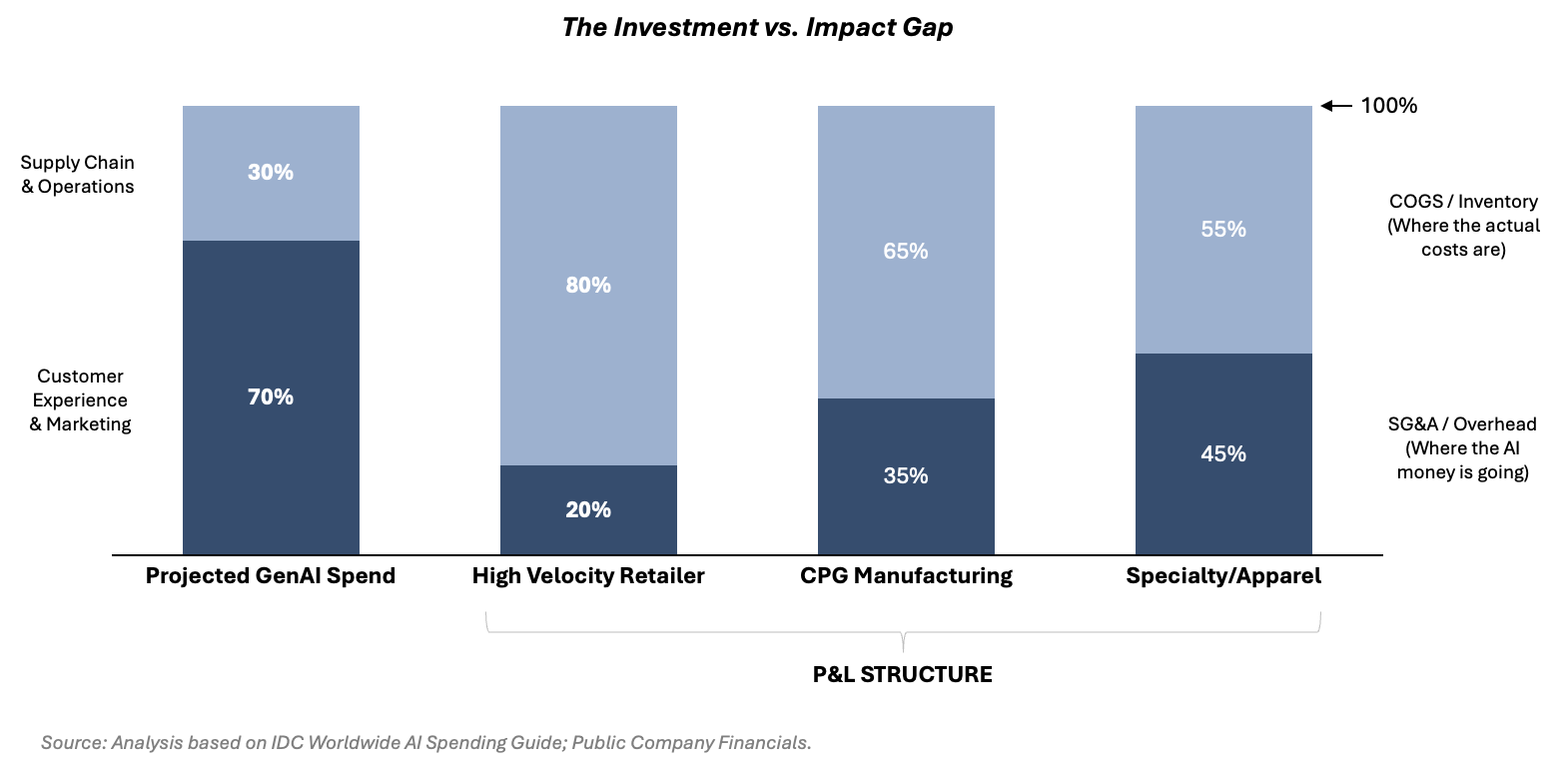
Think about that for a second. We are pouring investment into the smallest part of the P&L.
A chatbot that writes a perfect apology email for a late shipment is managing a symptom. The shipment was late because the forecast was wrong. The allocation was off. The replenishment decision sat on someone’s desk for three days. That’s the disease. The chatbot isn’t even in the same room.
Boards love activity metrics. Adoption rates. Pilot counts. Lines of code generated. I’ve seen organizations launch 30 AI pilots and still carry the same inventory overhang they had two years ago. If your AI is active but your inventory is stagnant, you are failing.
Why Averages Are Killing Your Margin
To understand why chatbots can’t solve this, you need to understand the math of the actual problem.
For decades, retail and CPG planning has relied on averages. And there’s an obvious reason for that. No human team can calculate demand for 50.000 SKUs across 2.000 locations, every day. That’s 100 million daily decisions. So we aggregate. We plan for “Men’s Knitwear” in the DACH region. “Outdoor Apparel” in the Nordics.
Customers don’t buy averages though. They buy a specific Navy Merino Wool Sweater in Size L at a store in Munich on a rainy Tuesday afternoon. Meanwhile the same item sits unsold in Paris.
The safety of averages is an illusion. What it actually produces are two silent killers.
Phantom Inventory. You’re overstocked in Store A, tying up capital in product that won’t move. Waste.
Phantom Demand. You’re out of stock in Store B, where the customer wanted to buy. Lost revenue.
Both destroy margin. Neither shows up in your chatbot dashboard.
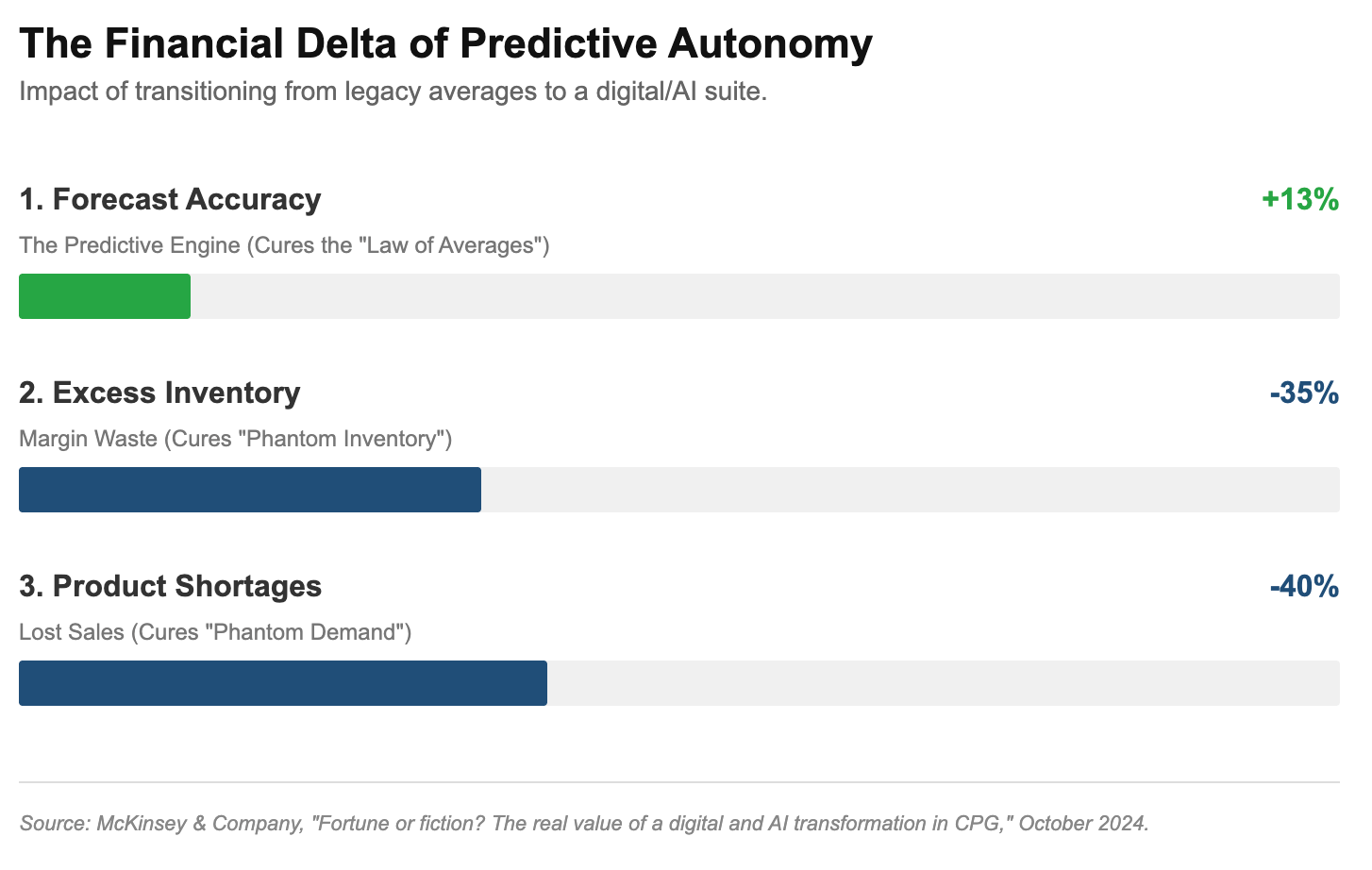
McKinsey’s October 2024 analysis puts hard numbers on what most practitioners already feel in their gut. By investing in a digital and AI suite, companies are improving forecast accuracy by 13 percent, decreasing product shortages by 40 percent, and decreasing inventory by 35 percent.2 Correcting this “Granularity Gap” is the single largest lever for margin improvement in retail and CPG today, capable of driving a five- to 15-percentage-point impact on EBITDA margins across the value chain.
A chatbot is not going to solve 100 million daily decisions. That requires a completely different architecture.
From Conversation to Control
During my time as an executive, my CEO had a mantra he repeated to every consultant who walked into the boardroom: “Don’t tell me I have a problem. I know I have a problem. Tell me how to fix it.”
Fair enough. So how do we fix it?
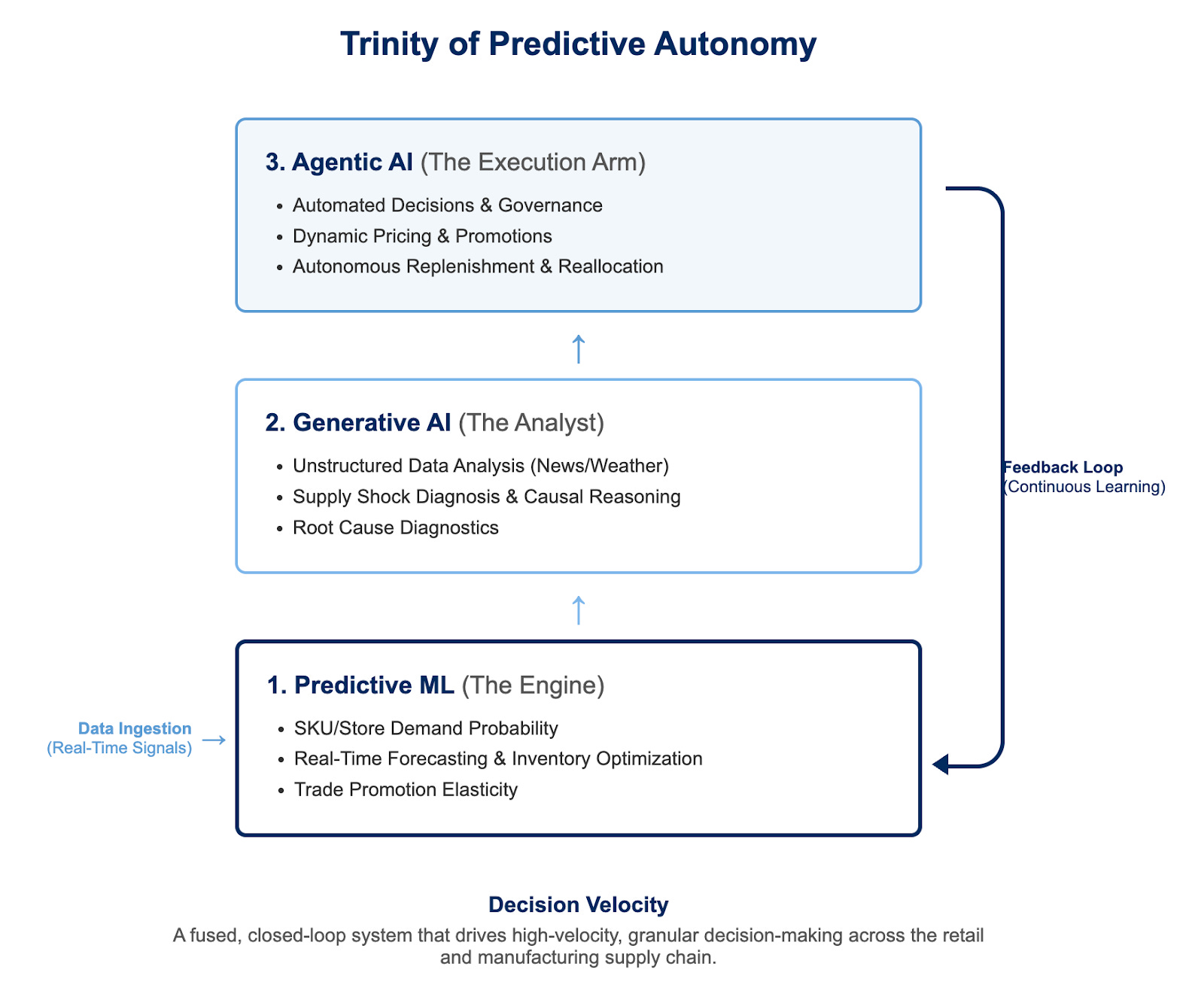
The answer is not “better GenAI.” It’s an architectural shift. Stop viewing GenAI as a standalone strategy and start positioning it as one component of a larger system. I call this the Trinity of Predictive Autonomy.
Three layers. All three must work together. Remove one and the whole thing collapses.
Layer 1: Predictive ML, The Engine
GenAI cannot do math. I know that sounds reductive, but it matters. It cannot process the multi-dimensional probability calculations you need for 100 million SKU/store combinations. For that you need the unglamorous work of Predictive Machine Learning.
ML gets dismissed a lot these days as “legacy AI.” That’s a mistake. GenAI might be the articulate front-end, but without ML feeding it actual numbers, there’s nothing behind it. You’ve got a narrator with no story.
One of the few real competitive advantages left in retail operations is granularity. Knowing that “yoghurt will sell in Berlin this week” tells you almost nothing. It leads to safety stock, which leads to waste. Knowing that ‘15 units of Strawberry Greek Yoghurt at Store #504 will sell by Tuesday 14:00’ is where the profit lives. For a CPG brand, it’s not just predicting consumer demand; it is predicting trade elasticity. Knowing that shifting €50.000 in trade promotion spend from a blanket national discount to a targeted regional campaign will prevent a stockout and yield a 12% higher lift.
Predictive ML senses those signals. It filters noise, processes history, and delivers the numerical truth of demand. Without this layer, everything else is guesswork. Articulate guesswork, maybe. But guesswork.
Layer 2: Generative AI, The Analyst
If Layer 1 gives us the “what,” Layer 2 gives us the “why.” This is where I think the industry has got GenAI completely wrong. It’s not a creator. It’s an analyst.
Here’s what actually happens in operations today. The predictive engine flags an anomaly. Could be a 20% dip in projected sales for a region. Could be a looming shortage of a critical ingredient flagged through supplier lead-time data. What follows? Analysis paralysis. A meeting gets scheduled. People start pulling up weather reports, scanning news, checking competitor pricing, calling suppliers. This takes three to five days. By the time someone identifies the root cause, the window for action has often closed.
GenAI can collapse that timeline to minutes. Take the retail side: the ML layer detects a spike in umbrella demand in London. GenAI reads the local weather data and picks up a news report about a transit strike. Commuters are walking instead of taking the tube, and it’s raining. Diagnosis complete. Or take CPG: the predictive engine flags a potential shortage, and GenAI instantly scans global news feeds and supplier logs, identifying that a port strike in Southeast Asia is disrupting the primary shipping route. In both cases, by the time a human planner would have opened the first spreadsheet, GenAI has already diagnosed the cause and passed the context forward.
Not writing marketing copy. Turning data into a diagnosis. That’s where it belongs.
Layer 3: Agentic AI, The Closer
Layers 1 and 2 create intelligence. Layer 3 is where you actually make money.
In most organizations today, AI is a recommender. It sends an alert to a human who then decides whether to click “approve.” That human-in-the-loop is the speed limit of your profitability. And I mean that literally. The time it takes for someone to review, discuss, and approve a pricing or allocation decision is margin evaporating.
Agentic AI breaks that. It takes the prediction from ML, the context from GenAI, and executes. Adjusts a price. Reroutes a shipment. Places a replenishment order. No committee required.
People worry that agents will go rogue. That’s a misunderstanding of how these systems are designed. Agents work within pre-defined guardrails set by the business. A retail agent might be authorized to auto-approve a markdown up to 5% when inventory age exceeds 30 days and footfall is declining. A CPG agent might autonomously reallocate a shipment of high-demand inventory away from a fully-stocked retail partner toward a region experiencing a sudden surge. Anything outside those parameters gets escalated to a human. The machine handles routine decisions at speed. Humans handle exceptions with judgement.
In retail, a price change executed next Tuesday is often worthless. The moment has passed. The agentic layer executes that markdown while the customer is still in the store. It reroutes the truck while it’s still at the junction.
That’s the shift. From weekly planning to real-time response.
The Infrastructure Problem Nobody Wants to Discuss
There is a reason the Trinity doesn’t exist yet in most organizations. And it’s not the AI. It’s the plumbing underneath it.
Most retailers spent the last decade consolidating data into massive lakes and warehouses. These are great for quarterly reports. For real-time decision-making, they are useless.
I’ll put it simply. If your data is 24 hours old, it’s not an asset. It’s a liability. You cannot ask an autonomous agent to make a real-time markdown decision while it’s looking at inventory levels from yesterday’s batch upload. The decision will be wrong before it’s even executed.
The infrastructure needs to move from centralized batch processing, the nightly sync that everyone has learned to live with, to event-driven architectures. Capture the POS transaction the moment it happens. Track the GPS coordinate of the truck in real time. Feed those signals directly into the system.
What I see consistently is organizations investing heavily in AI models while their data infrastructure quietly imposes a 24 to 48 hour delay on every decision. That’s a time tax on your margin. And no amount of model sophistication will compensate for it.
What To Do Now
The past three years were about experimentation. Chatbot pilots, internal search tools, marketing assistants. That was necessary. It built familiarity. But it hasn’t moved the P&L.
For leaders who are ready to shift from experimentation to impact, here’s what needs to happen in the next 90 days.
Audit your AI spend against your cost structure. If most of your AI budget is aimed at SG&A and your margin problem is in COGS, you have a misallocation problem. If a pilot is not directly linked to a COGS reduction or a 10:1 revenue return, freeze it. Redirect that capital toward predictive capabilities that touch inventory, logistics, and pricing.
Find your Granularity Gap. Pick one high-value category. Fresh food, high-fashion, seasonal goods. Measure the distance between how you plan today (regional clusters, weekly cycles) and where demand actually lives (SKU/store/day). That gap is your margin opportunity.
Define the guardrails for autonomous action. Sit down with your category managers and ask one question: “What decisions would you be comfortable letting a machine make if it had 95% certainty?” Their answers are the blueprint for your agentic layer.
Be honest about your data latency. Measure the time between a store event and when your planning systems can actually see it. If that number is in hours or days, not seconds, your infrastructure is the bottleneck. No AI investment will deliver full returns until you fix this.
The Cost of Waiting
In a low-margin, high-complexity European market, “wait and see” is not caution. It’s managed decline. The question isn’t whether autonomous decision-making will reshape retail and CPG. It’s whether you’ll build it or spend the next five years reacting to a competitor who did.
GenAI without prediction is hallucination. Prediction without action is just a report nobody reads. You need all three.
Stop asking AI to write for you. Start asking it to decide for you.
Footnotes
Worldwide Artificial Intelligence Spending Guide, 2024
McKinsey & Company, “Fortune or fiction? The real value of a digital and AI transformation in CPG,” October 2024